Tuesday, 17 May 2016


Galapagos and The Marquesas   May 17, 2016

 Hi All:

 
Galapagos (March 21 – April 8)

It is two weeks ago since we checked into the Galapagos and we are now making preparations to check out and undertake our really long sail (3000nm) to The Marquesas.

 
One of the Saddleback Tortoise

 
A Marine Iguana

Some of the lay abouts on Santa Cruz


We have seen quite a bit here at the archipelago, but nowhere near as much as we had anticipated. The Park Authority is very restrictive about where you can visit and practically always requires that a guide be in attendance. This makes perfect sense when you see the flora and fauna being protected. Our entry permit enabled us to stop at three island harbours, from where we were required to purchase day cruise packages. There are many areas we hoped to be able to visit, but were not allowed unless we were on a 3-4 day cruise ship program. Even if we hired a guide, we were not permitted. This sort of ruling does not sit well and in fact has convinced many cruisers, like us, to bypass the area on their way west. The high entry fees/bureaucratic rigmarole/travel restrictions/expensive travel packages seem to outweigh the benefit derived. The choice areas appear reserved for those on the pricey cruise ship plans. But there is a check mark on our bucket list.
 
Food and beverages at the grocery store are pricey because most is brought in by boat. Some examples: 1 liter long life milk: Panama $1/Galapagos $3, 1 liter box red wine – Panama $3/Galapagos $12, small jar Peanut butter: Panama $4/Galapagos $10. In short at least double the cost of everything, or more. Travel accommodation however is a bargain, with prices sitting around $20-$50/night, depending on the elegance of the room(s).

So we experienced the blue and green footed boobies (didn’t see red), the giant tortoises, the sea turtles, the penguins, the many sea lions and seals, the stately land iguanas and the black swimming ones. We had a lesson on the habits of the frigate birds. They are predatory and only eat what they can steal from other birds, acquired by catching the other birds in flight by the tail and shaking them until the prey regurgitated the food. We snorkelled amongst white tipped sharks and many tropical fish. There are some seriously beautiful beaches to stroll (without a guide), which was absolutely necessary because, the daily temperature is 8 degrees higher than average. This is having an impact on the food chain. I know we are losing weight.
 
Topography on island off Santa Cruz - pure dessert

Under every cactus were land iguanas - not so colourful since mating season was past

Blue footed boobie


At the end of our two week stay the boat was loaded with as much fresh produce as we could find, which wasn’t a lot. We purchased two stalks of green bananas to see us through our passage. Four days later all bananas had fallen off one stalk and the other was only days behind and we hadn’t even left port.


At Isabella Island we checked out making sure we had our zarpe – a document that signifies you have properly checked out at your last port and can be entered into the next. Without it you can be refused entry and be required to return to the last port and with 3000 nautical miles facing us ………….


The Marquesas: May 17’16

 
Our trip to the Marquesa Island group was not without its challenges. Firstly the traditional trade winds never materialized, so we did not enjoy what is known as the Coconut Milk Run.  At times there was zero wind and some of the purist sailors took down their sails and went to bed for the night.

A few days out of the Galapagos we lost the second auto steering, which necessitated hand steering for the bulk of the passage. The first died enroute to the Galapagos. Twin head sails purchased specifically for this run were too much for the head stay and damaged the furling mechanism relegating them useless. We had to use a smaller sail to maintain headway. We also flew a genaker (a very light air sail, which had never been flown) to make speed. But despite these handicaps, we still completed the passage in 24 days.
 

There were approximately 200 boats heading the same way (Tahiti) from various points east, at different times, under a common flag known as the Pacific Puddle Jumpers. It is a very informal regatta, with a daily radio net to keep track of one another, just in case help was needed. One boat we were monitoring was a single hander who left from Panama and was into his 45th day. But we are told the record is held by another single hander who took 60 days to complete the trip.
 

Being part of French Polynesia, The Marquesas are French possessions and rely on French support. We took time to visit five islands, each one providing a view into daily life. Our favourite was Fatu-Hiva simply because of the dramatic island topography. Trading fruit and meat for fishing gear, clothes or rope was more common than exchanging currency because obtaining the goods directly was easier than importing to the islands. Their homes are very basic with minimal furnishings, but all seemed to have the flat screen TV.
 

We ourselves are hampered by the inability to obtain repair materials. All must come via Tahiti, with a hefty transportation fee attached plus time delay.
Our favorite anchorage thus far - Fetu-Hiva

Today we are at our last Marquesian Island Nuku-Hiva (the Capital) trying to bring the boat into a suitable state of repair to handle the last 700 miles down to Tahiti. Since arriving in the Marquesas, the water maker has failed and requires parts not available until Tahiti. This is where the old definition of cruising is derived – cruising is fixing boats in exotic places.

Central Park in Atuona, Hiva-Oa
 

In the next few days we hope to visit Herman Melvilles’ (Moby Dick) home stead. We saw where Gaugin lived his lusty life style. Chicken is plentifull, if you can catch one as they all roam the islands free range. To get fresh produce here you must be at the local market around 5:00 am or it will all be gone. Even then variety is limited.
The view on Hiva-Oa from Paul Gaugin's grave site
Pretty good example of all Marquesian Islands - IMO
 

As usual, we feel we are just skimming the surface and not staying long enough to fully absorb this Polynesian life, but The Tuamotus andTahiti awaits……..M&G


Wednesday, 23 March 2016


Republic of Panama to The Galapagos

SV FreeWheel
 
February'16
We were able to get a direct flight from Toronto to Panama City, then hop into a taxi for a frenetic two hour ride (that cost almost as much as the flight), to Shelter Bay Marina, where we met up with Free Wheel. Shelter bay is on the north side of the isthmus (Atlantic) at the north end of the Panama Canal.  It is inside a decaying, but active Panamanian army base, once used by the US for jungle training of troops destined for  Vietnam. Where the marina ends, the jungle starts, so at dawn and dusk the howler and Capuchin monkeys set up quite a chilling chorus. Some mornings, we followed the old camp asphalt roads into the jungle to watch the monkeys flit across the tree canopy, being careful not to stand below them, because as a show of territorialism they would pee down on you, throw sticks, or worse, hurl their poop. Never being bird watchers, the jungle presented a colourful attraction that drew us more than once. On one walk Grace crossed paths with a black panther. This section of the jungle is also a national park.

Shelter Bay with abandoned barracks in distance
Unsuccessful drug boats in the military compound


We ended up staying in the marina far longer than planned owing to a botched repair job on the refrigeration, by a marina repairman. The new cooling plate was so damaged that a replacement had to be flown in from the US. As a result we were unable to visit the renowned San Blas Islands, but settled for a four day shakedown sail to Portobello. This deep bay was the focal point for the Spanish when shipping their pilfered Aztec gold back to Spain. We were told that there was so much gold at one point, the Customs house (see pic) became full, requiring the excess to be stored outside in the yard.

Portobello Bay
The customs building too small to hold the booty


While still waiting for the fridge part, we went to Panama City to enjoy the annual carnival, which had more LOUD music than substance. In fact, it is the first parade that we have ever seen twice because it looped to draw out the event. We later learned that the bigger carnival events are in the small towns and most city dwellers leave for those attractions. We had gotten it wrong again.


Embarra Indians
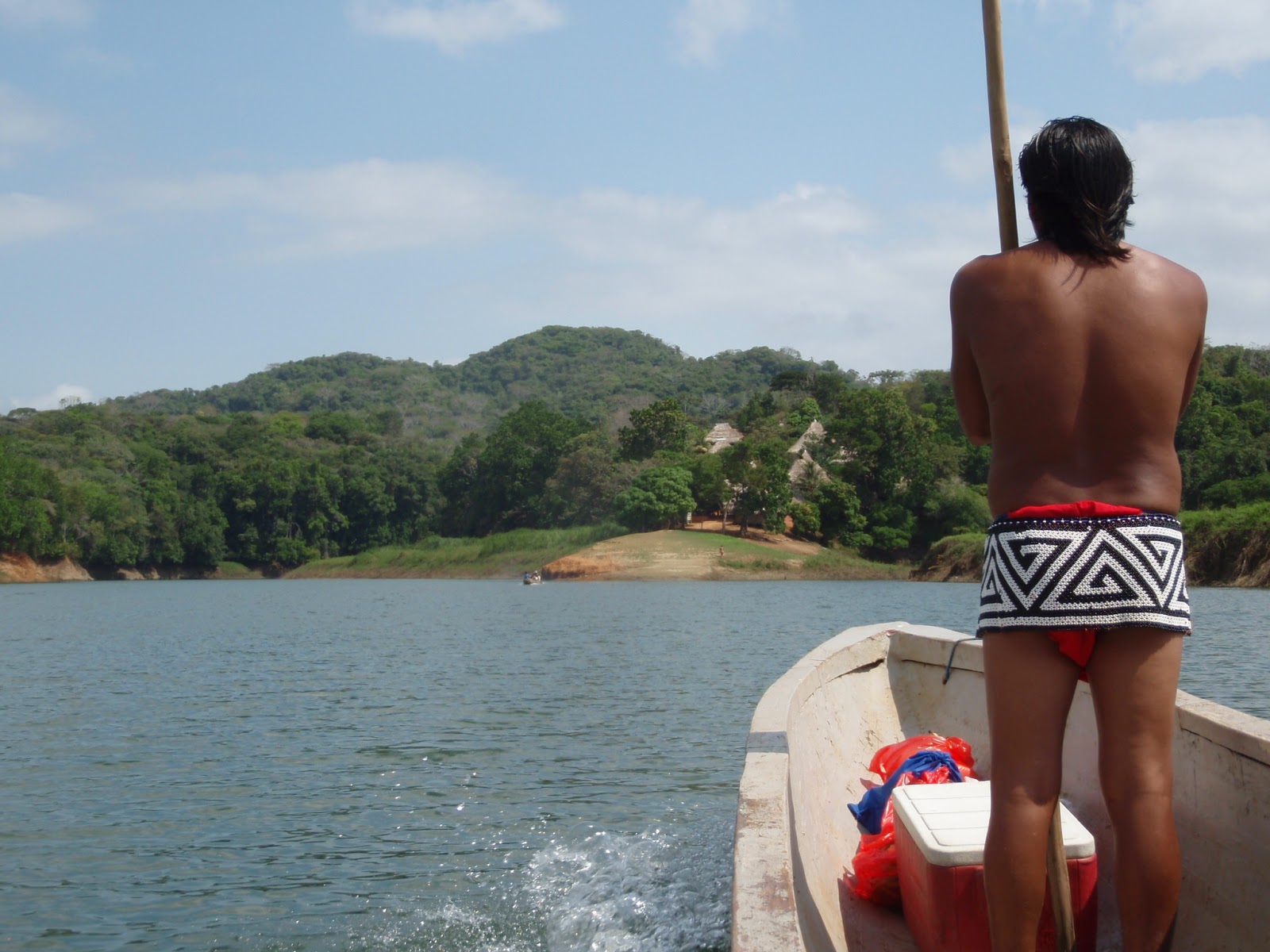
Like so many countries, treatment of their indigenous peoples is less than satisfactory. We visited an Embarra Indian village on the Chagress River, who today, exists only on tourism. In the eighties, their lands were decreed to be national park, such that they could no longer farm or hunt. The majority have moved to Panama City (35,000), with only 900 remaining in the park. We experienced an enjoyable day, learning about their history, their culture, their food and of course being able to purchase some of their high quality crafts.

Heading to the village


Canal Transit
With the fridge fixed and our allotted canal transit date arrived, we headed to the anchorage to await the arrival of out pilot. Every boat is required to have four line handlers, a helmsman and a pilot. We were now into “hurry up and wait” mode. The pilot arrived three hours late and insisted we hurry up.

 The 80 km. canal consists of two sets of locks (three up/three down), with a man made fresh water lake in the middle. Non commercial boats are rafted together and pass through when the schedule allows. Our transit took two days because we locked up at dusk, picked up a mooring ball for the night and completed the trip the next day (after our new pilot finally decided to show up). Coming out of the first set of locks, we found water spraying all around the engine room (a loose hose caused by a rotted hose clamp). While still motoring to the anchorage, I had to replace the clamp and stop water egress, otherwise the pilot could declare us unfit to complete the transit. This could have meant rescheduling our passage through, plus further costs atop of the prepaid fees. (translates into another $1000+ because of a $5 clamp).


Following the channel through the man made lake was boring and in fact apart from the clamp episode and excitement in the very last lock, it was hot and dull. We have now done it once and don’t want to do it again.
 

In the very last lock we found there to be a current drawing the raft quickly towards the down stream lock gates. The pilots apparently knew about this, but said nothing. The longshoremen, who took our lines, had put them in the wrong place, so the raft started going sideways approaching the wall. Helmsmen of the raft started bellowing instructions when the pilots should have been in control. It took a lot of straining on the lines to bring the raft under control. In preparation for the trip I had read about boats being damaged in this Miraflores lock, but could not understand why. Everything seemed so benign.

A tight fit


Its looks so innocent, even now
We stayed for a few days, at anchor, outside of Panama City, taking on car loads of provisions, in preparation of our jump to the Galapagos and beyond.


Panama to Galapagos

This 980 nm trip took us eight days because the winds were variable to none. At the equator sits the ITCZ (doldrums) where the north and south weather patterns converge. Being first timers, we were all looking forward to crossing the equator. In fact we did it three times drifting back and forth with the current and breeze. The engine had died and it took six hours in the hot engine room to find that a small orifice in the fuel filter was plugged with crud from the fuel tanks.

Crossing the line - the first time
 
While at sea, when the waters were oily flat, the skipper scrubbed the entire bottom of the boat because of the stringent entry rules into the Galapagos. Upon arrival at our port of entry on San Cristobal, nine officials boarded us all at once. Two men dove to inspect below the waterline, there was our agent, police, immigration, customs, harbour master, naval officer and a guy who fumigated the boat such that we had to leave for two hours, right when it started to rain. And did it rain! For over two hours it was more than torrential. The streets quickly became rivers.

 So we have been at anchor here for two days and I have discovered that I (Mike) like boobies, especially the blue ones. (Although the red ones are also nice). The seals are without fear and sleep where ever they want. The local boats are ringed with barbed wire as a deterrent. Freewheel has a stern scoop, leading to a vertical three step ladder and a gate. In the middle of the night a seal was able to negotiate the ladder and the gate to sleep on the deck. Come morning all that was left was his calling card(s).


We expect to stay in the archipelago for about twenty days, so hope to have more before we leave. Until then…………..M&G


Mr Noreago's current address - the prison adjacent to the canal


10 minutes after dropping anchor in the Galapagos

Will this finally shut up the rumours about my lack of fishing ability?
local bus transport - US school buses with a take no prisoner attitude


Monday, 21 September 2015

Sardinia -Belarics - Southern Spain


Sardinia to Southern Spain - end of season 11

 
Hi All:

 Hard to believe, but our sailing season is at an end. Although at times, we felt like it would never end (like when motoring into the ever present Mediteranean chop). But now we look back and think, where did the time go.

We have logged into our winter mooring in Almerimar, Spain, which is about 130 miles east of Gibraltar. Gib was our target, but the nearby marina there disallowed staying on your boat while you worked on it. Plus you had to pay the marina an additional 10-20 euros per day if you did your own work and not hire their “professionals”.

 Doing our annual tally from Monfalcone, Italy to Almerimar we put 2400 nautical miles under our keel and well over half of that was motoring.  The seasonal winds are prdominately NW, which was ideal for the direction we were heading. So where did all this SW originate?

Sardinian coast
 Since our last post we have visited  Sardinia, Minorca, Mallorca, Ibiza and finally  back to southern Spain. Southern Spain, Ibiza and Mallorca, we had visited before, and it was about there where we lost our transmission for the second time five years ago and the winds took us on a five day detour to Tunisia. This was just in time to witness the start of the Arab Spring.


The evening promenade after the day's heat - Alicante, Spain
 Although the sailing (motoring) was enjoyable and the crystal clear azure water is never something you would tire of, we didn’t find this later part of the season stirring the blood as before. This may have been due to: the anchorages being crowded because of high vacation season: fewer virginal anchorages-most now rimmed with condo and hotel walls with swimming buoys dominating the anchorages. It seemed to be acceptable to launch your overpowered inflatable dinghy and race through the anchored boats pulling a water skier or some inflatable chair.  Apart from the ongoing noise and wake, swim at your own risk was the rule. Less opportunity to anchor in the region meant increased use of marinas, which at high season rates (double, sometimes treble winter rates) dampened the desire to dawdle and explore the nearby town further. Cartagena, however, was an exception. We thoroughly enjoyed this “old style” Spanish town. Mahon , Menorca was also an unexpected treat.
The deep sheltered harbour of Mahon
Mahon harbour


Mahon


Almerimar - This whole region is a 30 year old planned community. Just outside the wall of condos, which rim the marina is the market garden of Europe. Plastic covered fields stretch as far as the eye can see. Apparently from space the whole area appears as one big white splotch. Two or three crops a year are grown of salad type vegtables, zucchini, etc. When we passed through here five years ago, we noted that half the condos and stores in the complex were empty. Today – no change. A very large community of live aboard boaters stay here for the winter. In fact quite a few boats are here that look like they haven’t moved in 5+ years. Many appear sadly abandoned.

The plastic green houses
 
Plastic green houses visible from space
Just a few days before we were to leave for home the weather turned very sour. By now we were on the hard and stripping everything off for the winter storage. The skies became very foreboding. At the height of the storm the rain was so dense we couldn’t see the boats stored next to us. Rain drove horizontally and poured in through the dorades and down the mast. The boat was shuddering on its cradle. It was a day later that we learned a twister (water spout doesn’t seem appropriate) had touched down about 250 meters away from the boat, but on the other side of the sea wall from the marina. Amazingly there was no serious damage to any boats. The locals said repeatedly – we have never had anything like this here-ever! We were later told that this region of Spain – now called Costa del Sol (sunshine coast) was previously called Costa del Vente (windy coast). It was supposedly changed in order to assist the condo developers in marketing their units. Who in their right mind would want to buy a retirement home (or leave their boat) on a wind driven coast.  Let’s hope the locals won’t have cause to say – yeah, this one was even stronger than the last one!


So today we are home in Waterloo (watching the Spanish weather on line) and awaiting the imminent arrival of grandchild number two.


Good wishes to you all.  Adios…….Mike and Grace

Our anchor and chain in 10 meters
 

Croatia & Italy


Croatia and Italy  - June 2015 (The Boot, Aeolian Isles, Messina Straights)

Hi All:

Since our last post we have passed south through Croatia; crossed the Adriatic to Italy’s east coast; around the Boot; up through the Messina Straights (separates Italy and Sicily) and have just left behind two of the volcanic islands in the Aeolian chain. We are posting this From Sardinia

Croatia
Croatia was a delight, primarily because we linked up with other boats with just a couple as crew. Croatia apparently has the world’s largest fleet of charter boats and in order to share cost, they usually have a crew of eight with a sailing agenda to get as many miles under the keel in the allotted period, so little time remains for socializing with other boats.
While in Croatia, we experienced our first (and hopefully last) Bora. This is a strong NE wind from the top of the Adriatic. Fortunately you receive adequate warning of its coming, so we were able to tuck away in a secure anchorage and prepare. Once again our oversized dinghy revealed its alter ego as a kite, so it was a cockpit watch night.
Dubrovnik - note the playing field

Despite the proliferation of walled/red tiled roofed ancient cities along the Croatian coast we still stopped in at Dubrovnik. It is “the” tourist stop for Croatia, but we found it to be well worth the time and effort (desite $$$$). There were five cruise lines at dock when we arrived. Walking the walls provided a great overview, particularly at 0800 before hordes from the  cruise ships arrived. It is all very inspiring and picturesque, with nothing to remind you of the 90’s troubles, when the city was aggressively bombed.
The Dubrovnik Marina "offices"

SE Italy
Next we crossed over to Italy and continued south. This part of the coast we found to be low and uninspiring. It is not until you follow around the Boot that interest builds. The topography is generally ragged with agriculture spotted where possible. It is a part of the country we would definitely like to return to explore, but in a four wheeled cruiser.


Messina Straights
We approached the portion of our passage with a slight apprehension because of reports of shipping congestion, unfriendly seas from the

winds and 3-4  knot tidal currents, winds barrelling down from the high hills on either side and over zealous officials monitoring ship activity in the Straights. Short story is it was a non event. We hit the tides correctly; the channelling winds went easy on us; there was very little shipping activity to be of concern and the officials didn’t even want to know about us. All that nail biting for nothing.
We even went looking for the whirpools that appear at times in the tidal flood. The most prominent one, referenced in the Odessey – called the Charybdis  (“the Sucker-down”) wasn’t to be seen. But what we did encounter however was the fishing boats who target the swordfish swimming northward June-July.
The operation is essentially a three man crew, two in the crows nest steering the boat and searching for prey sunning themselves near the surface. The third man is two boat lengths ahead seated in a pulpit armed with a harpoon. It was a good thing to see these boats out because they only operate in calm weather – not hard to understand why.
Try to pick out the guys up the crows nest and off the bow

Aeolian Islands
Our purpose in coming north through the Straights was to see two volcanic Islands. Vulcano, which is asleep, thus we were able to climb to the crater rim, but sulphurous gas stopped us going any higher. Stromboli, which remains active and needed to be viewed after sunset. It is referred to as the lighthouse of the Mediterranean, because sailors have used it as a reference point for eons. We anchored along the narrow shore awaiting nightfall and when motoring past received, frankly, an underwhelming display. We were given three good burps at best, far from our expectations. We continued on through the night  and it was then we saw the real light show. In the pitch dark the thousands of jelly fish glowed like 10 watt light bulbs in our wake.
Volcano - from the anchorage

Vulcanos Crater

Vulcanos sulpherous gas
We motored on for 19 hours to the last Aeloian Island Ustica, but couldn’t stay to explore because the only harbour was jam packed with local run abouts. We spent the night on the ferry dock, but had to vacate early the next morning before the ferry’s arrival.
We then had a 34 hour motor to Sardinia, where we are posting this blog. As we have said before, this is the Motorterranean – not the Mediterranean.


Being investigated by the  Italian Coast Guard


PS – Winlink2000 position reports – perhaps it just me, but when I have checked this website, after entering our call sign  VE3MTI – I get a message that says something like – no postion reports for 10 days/check the history. When I accept that option everything is there up to date.

This is how all our days end
Caio Caio.........Mike and Grace